



Finding dark, coarse hair sprouting on your chin, upper lip, or jawline is more than a cosmetic frustration—it’s often a signal that your hormones are out of balance. If you’ve been plucking, waxing, or threading for years without addressing why this hair keeps growing, you’re treating the symptom while the root cause persists. Hormonal facial hair, medically known as hirsutism, affects millions of women. The culprit is almost always excess androgens (male hormones like testosterone) or an imbalance between your estrogen, progesterone, and testosterone levels. Conditions like PCOS, perimenopause, and postpartum hormonal shifts commonly trigger this unwanted growth. The good news? Effective treatments exist. While many women try surface-level solutions, clinical evidence shows that addressing hormonal imbalance at its source delivers the most comprehensive, lasting results.
Key Takeaways
- Hormonal imbalance is the root cause: Excess androgens or insufficient estrogen and progesterone drive facial hair growth in women
- Bioidentical hormone therapy addresses the source: Restoring hormone balance can reduce androgen dominance and slow unwanted hair growth
- Progesterone reduces DHT conversion: This master hormone blocks the pathway that triggers facial hair, acne, and hair loss on your scalp
- Diet and lifestyle provide supportive benefits: Anti-inflammatory eating and stress reduction help but rarely solve the problem alone
- Herbal remedies offer mild effects: Spearmint tea and saw palmetto show some anti-androgen activity but lack the potency of hormone restoration
- Surface treatments manage symptoms only: Waxing, threading, and topical creams don’t address why hair keeps returning
- Comprehensive treatment beats fragmented approaches: One hormone-balancing solution outperforms multiple partial fixes
1. Bioidentical Hormone Therapy: Addressing the Root Cause
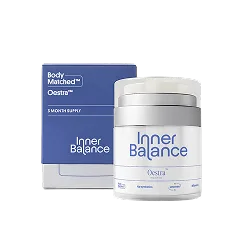
At Inner Balance, we’ve developed a comprehensive approach that targets what’s actually driving your hormonal facial hair: imbalanced hormones. Our Oestra™ vaginal cream combines bioidentical estradiol and progesterone—the exact hormones your body produces naturally—in a single formulation designed to restore balance.
Why Hormone Restoration Works for Facial Hair
Hormonal facial hair develops when androgens (testosterone and DHT) become dominant relative to your estrogen and progesterone. This happens during perimenopause, with PCOS, or when your ovaries aren’t producing sufficient balancing hormones.
Progesterone plays a critical role here. It reduces DHT conversion—the pathway responsible for facial hair growth, acne, and even scalp hair loss. When progesterone levels decline (which begins in your 30s for most women), androgens gain the upper hand.
Our Oestra™ formulation delivers both estradiol and progesterone vaginally, which offers distinct advantages over pills or topical creams:
- Higher bioavailability: Vaginal absorption bypasses liver metabolism, delivering more active hormone to your system
- Steady hormone levels: No peaks and valleys that trigger symptoms
- Vaginal tissue is highly vascular: This route can support absorption, but the degree of systemic uptake depends on dose, formulation, and individual factors
- Targeted vaginal delivery: Vaginal administration can preferentially deliver some hormones to reproductive tissues; effects on symptoms outside the pelvis depend on dose and individual response
The Science Supporting This Approach
Pharmacokinetic research confirms that vaginal progesterone achieves reliable circulating levels—essential for counteracting androgen dominance. Unlike oral progesterone, which gets broken down by your liver into sedating metabolites, vaginal delivery provides more usable hormone with fewer side effects.
For women with PCOS specifically, restoring progesterone and estrogen calms the overstimulated ovary and counteracts testosterone dominance. This addresses the hormonal chaos driving facial hair, acne, and irregular cycles simultaneously.
What Our Patients Experience
Based on internal patient reports at approximately 6 months:
- Around 97% report improved vaginal dryness
- Around 70% observe positive skin and hair changes
- Around 79% see mental health improvements
- Around 68% notice reduced brain fog
- Around 81% experience better sleep quality
While these results span multiple symptoms, they demonstrate how comprehensively hormone restoration works. When you balance estrogen, progesterone, and testosterone, multiple concerns improve because you’re addressing the underlying cause.
What Sets Inner Balance Apart
- All-in-one solution: Single cream replaces multiple prescriptions
- Personalized dosing: We adjust based on your symptoms, not arbitrary lab values
- Ongoing support: Unlimited consultations with our care team
- Proven safety: Made in FDA-regulated 503B pharmacy with rigorous testing
- Comprehensive approach: Treats facial hair alongside mood, energy, sleep, and libido concerns
Inner Balance provides a comprehensive solution for women 21+ with hormonal facial hair linked to PCOS, perimenopause, or hormonal imbalance who want to address the root cause rather than managing symptoms indefinitely.


2. Spearmint Tea: A Mild Anti-Androgen Option
Spearmint tea has gained attention for its potential anti-androgen properties. Some women report reduced facial hair growth after drinking 2-3 cups daily for several months.
How It Works
Spearmint contains compounds that may reduce free testosterone and increase estrogen levels. The proposed mechanism involves blocking androgen receptors and inhibiting enzymes involved in testosterone production.
What It Offers
- Accessible and inexpensive
- Pleasant-tasting daily ritual
- No prescription required
- May provide modest testosterone reduction
- Effects are subtle and develop over time
- Requires months of daily consumption for potential benefits
- Results vary between individuals
- Works well as complementary support to hormone therapy
Spearmint tea offers mild support as part of a comprehensive approach. For women with significant hormonal imbalance, this works well alongside bioidentical hormone therapy.
3. Anti-Inflammatory Dietary Changes
What you eat influences your hormone balance. An anti-inflammatory, low-glycemic diet can support hormone regulation and reduce androgen levels, particularly for women with insulin resistance.
How It Works
High blood sugar triggers insulin spikes, which stimulate your ovaries to produce more testosterone. By stabilizing blood sugar with fiber-rich vegetables, quality proteins, healthy fats, and low-glycemic carbohydrates, you can reduce this androgen-driving cascade.
Key dietary strategies include:
- Prioritizing cruciferous vegetables (broccoli, cauliflower, Brussels sprouts)
- Including omega-3 fatty acids from fish, flaxseed, and walnuts
- Reducing refined sugar and processed foods
- Adding phytoestrogen-rich foods like flax and legumes
- Maintaining adequate protein intake
What It Offers
- Supports overall health beyond facial hair
- Can improve insulin sensitivity
- Complements other treatments effectively
- Requires significant lifestyle commitment
- Results take months to appear
- Dietary changes create a supportive foundation that works best when combined with comprehensive hormone treatment
Anti-inflammatory eating optimizes your hormone environment and pairs well with bioidentical hormone therapy for comprehensive results.
4. Saw Palmetto Supplements
Saw palmetto is an herbal supplement traditionally used for prostate health in men. Its mechanism—blocking the enzyme that converts testosterone to DHT—has led to interest in using it for hormonal facial hair in women.
How It Works
Saw palmetto inhibits 5-alpha-reductase, the enzyme responsible for converting testosterone into the more potent DHT. Since DHT drives hair growth in androgen-sensitive areas (face, chin, upper lip), reducing it may slow facial hair growth.
What It Offers
- Available without prescription
- May reduce DHT-related symptoms
- Well-tolerated by most women
- Relatively affordable
- Limited research in women specifically
- Effects are modest
- Can interact with hormonal medications
- Quality varies between brands
Saw palmetto targets one piece of the puzzle—DHT production—while bioidentical progesterone also reduces DHT conversion and restores the estrogen-progesterone balance. Many women use saw palmetto as supplemental support alongside hormone therapy.
5. Inositol Supplements (Myo-Inositol and D-Chiro-Inositol)
Inositol has gained significant attention for PCOS management. This B-vitamin-like compound improves insulin sensitivity and may help reduce androgen levels in women with insulin-resistant hormonal imbalance.
How It Works
Inositol improves how your cells respond to insulin, reducing the insulin spikes that drive testosterone production. Many women with PCOS have impaired inositol metabolism, making supplementation potentially beneficial.
The typical combination is myo-inositol (2-4g daily) plus D-chiro-inositol in a 40:1 ratio, mimicking the body’s natural balance.
What It Offers
- Strong research base for PCOS specifically
- Improves metabolic health markers
- Generally well-tolerated
- May support fertility alongside facial hair concerns
- Most effective for insulin-resistant women
- Takes 3-6 months to show results
- Requires consistent daily dosing
For women with PCOS, inositol addresses the metabolic component driving androgen excess. It works well as metabolic support alongside hormone balancing treatment that addresses progesterone deficiency, estrogen levels, and ovarian function.
6. Stress Management and Lifestyle Modifications
Chronic stress can elevate cortisol and disrupt the brain–ovary signaling that supports consistent ovulation, which may contribute to lower progesterone and more hormone-related symptoms over time. Sleep deprivation, overexercising, and ongoing emotional stress can all worsen androgen-related symptoms.
How It Works
When cortisol stays elevated, your body prioritizes stress response over reproductive hormone production. This can suppress progesterone, disrupt ovulation, and allow androgens to dominate. Managing stress through sleep optimization, mindfulness practices, and appropriate exercise can support hormone balance.
Key strategies include:
- Prioritizing 7-9 hours of quality sleep
- Practicing stress-reduction techniques (meditation, yoga, deep breathing)
- Moderating exercise intensity
- Reducing environmental toxins that act as endocrine disruptors
What It Offers
- Free or low-cost to implement
- Improves overall wellbeing
- Supports other treatments effectively
- Indirect effects on facial hair
- Requires consistent effort
Stress management creates optimal conditions for hormone balance and supports any treatment approach. These practices complement hormone restoration for comprehensive results.
7. Topical Solutions and Hair Removal Methods
From threading and waxing to prescription creams like eflornithine, topical approaches manage the visible symptom of hormonal facial hair.
How They Work
- Eflornithine (Vaniqa): A prescription cream that inhibits an enzyme required for hair growth. Slows regrowth but doesn’t remove existing hair.
- Waxing/Threading/Sugaring: Removes hair from the follicle for 2-6 weeks of smoothness
- Laser Hair Reduction: Targets melanin in hair follicles for longer-term reduction
- Electrolysis: Destroys individual follicles permanently
What They Offer
- Immediate visible improvement
- Multiple options at various price points
- Can be combined with hormonal treatment
- Laser and electrolysis offer lasting reduction
- These methods address appearance and work well alongside hormone therapy
- Many patients find they need less hair removal once their hormones are balanced
Surface treatments provide cosmetic improvement and pair well with hormone therapy for comprehensive results—addressing both the visible symptom and the underlying cause.
The Comprehensive Approach
Notice the pattern across treatments #2-7? Each addresses a piece of the problem—androgens, insulin, stress, visible hair—while hormone restoration addresses the core imbalance.
Your facial hair is a symptom. The root cause is typically low progesterone relative to androgens, declining estrogen during perimenopause, or the hormonal chaos of PCOS. Addressing this balance provides comprehensive relief.
Many women combine supportive approaches like spearmint tea, dietary changes, and supplements with bioidentical hormone therapy for optimal results. The NAMS guidelines confirm that bioidentical hormone therapy offers Level I evidence—the highest quality scientific proof—for treating symptoms of hormonal imbalance.
The Bottom Line
Hormonal facial hair deserves comprehensive solutions. While spearmint tea, dietary changes, and supplements offer supportive benefits, they work best alongside comprehensive hormone restoration that addresses why this hair keeps growing.
Inner Balance’s Oestra™ targets the root cause: imbalanced estrogen, progesterone, and testosterone. By restoring these hormones with vaginal bioidentical delivery, you address facial hair alongside mood, sleep, energy, and metabolic symptoms—all in one treatment.
If you’ve been managing hormonal facial hair with partial solutions, consider whether treating the cause might finally give you lasting relief.
Frequently Asked Questions
What makes Inner Balance different from other hormone therapy options?
Inner Balance uses vaginal delivery of bioidentical hormones, which achieves higher bioavailability than oral pills or topical creams. Our Oestra™ combines both estradiol and progesterone in one formulation, eliminating the need for multiple prescriptions. We also personalize dosing based on your symptoms—not arbitrary lab values—and provide ongoing support through our care team.
How does progesterone help with facial hair specifically?
Progesterone reduces DHT conversion—the hormonal pathway directly responsible for facial hair growth, acne, and even scalp hair loss. When progesterone declines (starting in your 30s for most women), androgens like testosterone and DHT gain dominance. Restoring progesterone helps rebalance this ratio, slowing androgen-driven hair growth at its source.
How long does it take to see improvement in facial hair with hormone therapy?
Hormonal facial hair responds gradually because hair grows in cycles. Most women notice reduced new hair growth within 3-6 months of balanced hormones. Existing hair may continue its growth cycle, so combining hormone therapy with hair removal methods during the transition makes sense. Patients typically report that they need progressively less hair removal over time.
Can I switch from my current hormone provider to Inner Balance?
Absolutely. Many women come to us after trying oral hormones, patches, or other formulations without complete relief. Our vaginal delivery method offers distinct advantages, and our comprehensive approach addresses multiple symptoms simultaneously. Our care team can guide your transition safely.
What if I’ve tried supplements and natural treatments without success?
This is common. Supplements and lifestyle changes support hormone balance but work best when combined with bioidentical hormones. If you have PCOS, perimenopause, or another hormonal condition, comprehensive hormone restoration addresses what supplements alone cannot—restoring the hormones themselves for lasting relief.